
Reporter Constructs
and pEPito Plasmids
Reporter constructs to go – ready-to-use reporter gene plasmids and Minicircles

PlasmidFactory provides a portfolio of ready-to-use reporter gene plasmids and Minicircle DNA constructs designed for fast-track experimental workflows.
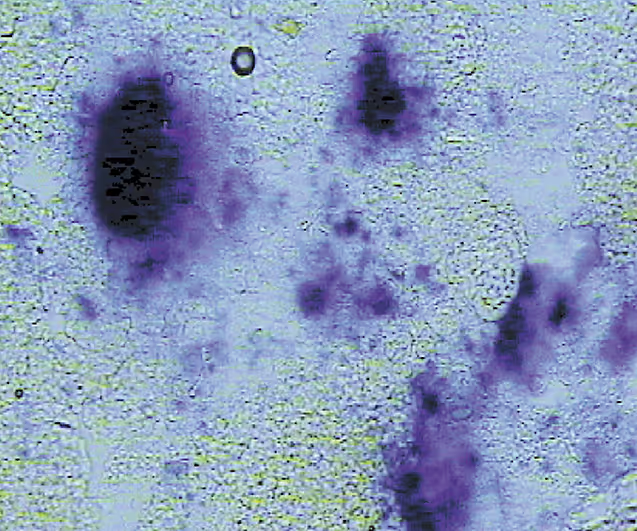
Our products include standard reporter genes such as GFP (Green Fluorescent Protein), luciferase (luc), and β-galactosidase (LacZ), optimized for high expression in a variety of systems.
Moreover, we offer our proprietary pEPito plasmids, representing an advanced iteration of the well-established pEPI family with S/MAR elements.
Reporter vectors and pEPito plasmids are available from our In-Stock service for immediate delivery:
- Guaranteed amount and reproducible quality with constant specifications of the pDNA, including verified LPS-Endotoxin removal, and culture free from animal-derived media.
- Precisely defined quality standards and homogeneous product, thanks to our proprietary CGE analysis technology for the quantification of different plasmid topologies.
Finally, we offer the McBox®, reporter systems for direct comparison of Minicircle DNA and the corresponding plasmid in experimental settings


In-Stock:
Reporter plasmids & Minicircles
Our ready-to-use reporter plasmids and Minicircle constructs are available from our In-Stock service and can be shipped at short notice, reducing the need for in-house cloning, preparation, and quality control.
They provide reliable tools for monitoring transfection efficiency, validating promoter activity, studying gene regulation, and performing in vivo imaging or functional assays.
| Item No. | Name | Special features | Vector size |
|---|---|---|---|
| PF0450 | pUC21 | Control plasmid, Amp resistance | 3.2 kbp |
| PF0451 | pUK21 | Control plasmid, Kan resistance | 3.1 kbp |
| PF0464 | pCMV | Control plasmid, CMV, Amp resistance | 3.5 kbp |
| PF0461 | pCMV-luc | CMV, firefly luciferase, Amp resistance | 6.2 kbp |
| PF0462 | pCMV-lacZ | CMV, β–galactosidase, Amp resistance | 7.2 kbp |
| PF0463 | pCMV-GFP | CMV, GFP, Kan resistance | 3.5 kbp |
| MC3048 | MC.CMV-luc | CMV, firefly luciferase, no bacterial backbone (e.g.,no resistance gene, no ori) | 3.6 kbp |
| MC3291 | MC.CMV-lacZ | CMV, β–galactosidase, no bacterial backbone (e.g., no resistance gene, no ori) | 4.6 kbp |
| MC3293 | MC.CMV-GFP | CMV, GFP, no bacterial backbone (e.g.,no resistance gene, no ori) | 1.8 kbp |


pEPito plasmids with
S/MAR elements
S/MAR elements (scaffold/matrix attachment regions) are anchor sequences that link independently regulatable chromatin domains to the protein skeleton of the nucleus of eukaryotic cells, creating an autonomous and therapeutically relevant expression system that avoids genomic integration.
In addition to supporting transcription and protecting against inactivation of (foreign) genetic information, a specific feature of these S/MAR elements has proven particularly important for the production of highly efficient plasmid DNA. Plasmids that contain a S/MAR element inserted at a defined location, in addition to the therapeutically effective gene, are replicated episomally and passed on as independent units to the daughter cells of the eukaryotic target cell.
| Item No. | Name | Special features | Vector size |
|---|---|---|---|
| PF1160 | pEPito-hCMV/EF1-EGFPLuc | hCMV enhancer, EF1 promotor, eGFP, firefly luciferase, S/MAR, Amp and Zeo resis | 7.0 kbp |
| PF1161 | pEPito-CMV-EGFPLuc | CMV-IEP, eGFP, firefly luciferase, S/MAR, Amp and Zeo resistance | 7.0 kbp |
| PF1162 | pEPito-CMV-EGFP-IRES-BSD | CMV-IEP, eGFP, IRES, BSD, MARS, Amp and Zeo resistance | 5.8 kbp |
| PF1163 | pEPito-hCMV/EF1-EGFP-IRES-BSD | hCMV enhancer, EF1 promotor, eGFP, IRES, BSD, S/MAR, Amp and Zeo resistance | 5.7 kbp |
| PF1164 | pEPito-hCMV/EF1-EGFP | hCMV enhancer, EF1 promotor, eGFP, S/MAR, Amp and Zeo resistance | 5.2 kbp |
| PF1165 | pEPito-CMV-EGFP-IRES-BSD-∆S/MAR | CMV-IEP, eGFP, IRES, BSD, Amp and Zeo resistance | 3.9 kbp |
| PF1166 | pEPito-hCMV/EF1-EGFP-IRES-BSD-∆S/MAR | hCMV enhancer, EF1 promotor, eGFP, IRES, BSD, Amp and Zeo resistance | 3.8 kbp |

All In-Stock reporter constructs and pEPito plasmids are pre-produced in Research Grade quality and are therefore available at short notice. Other quality grades are available on request.
References
- Trollet, Bigey and Scherman, Chemical and Genetic Pharmacology, Université René Descartes, Paris Ref. [1] and [2] in M. Schleef (ed.), DNA Pharmaceuticals, Wiley-VCH, 2005
- Rudolph, Maucksch and Aneja, Kinderklinik and Polyklinik, Dr. v. Haunersches Kinderspital, LMU München
- Walther and Stein, Max-Delbrück-Center for Molecular Medicine, Berlin