
mRNA Vaccines
Introduction
In vitro transcription (IVT) is at the heart of mRNA, self-amplifying RNA (saRNA), circRNA, and RNA vaccine manufacturing. The integrity, topology, sequence design, and purity of the DNA template directly influence transcription yield, product homogeneity, downstream purification burden, and ultimately patient safety.
Developers are moving toward streamlined, non-viral manufacturing concepts and in-house RNA platforms. To avoid upstream bottlenecks, they need DNA templates that scale seamlessly from research and preclinical development to GMP-aligned production – without compromising quality, documentation, or process robustness.
PlasmidFactory supports RNA development programs with high-purity plasmid DNA and bacterial backbone-free Minicircle DNA, robust linearization services, Capillary Gel Electrophoresis (CGE)-based topology analysis, Research to GMP quality grades, and proprietary POLYARESCUE® technology for stable, high-quality, transcription-ready templates.


The challenge
mRNA and RNA template developers commonly face bottlenecks that affect IVT performance, product consistency, and clinical translation:
- Suboptimal IVT yields and variability: Heterogeneous DNA topologies such as open-circle, nicked, or multimeric species can reduce effective template concentration and impair transcription efficiency.
- Undefined transcription start/stop and product heterogeneity: Circular or incompletely linearized DNA may drive read-through transcription, creating over-length or heterogeneous RNA species.
- Backbone-derived impurities: Bacterial backbone elements such as origins of replication, antibiotic resistance markers, and non-coding DNA increase impurity load and complicate downstream purification.
- Poly(A) tail instability: Long poly(A) stretches are difficult to maintain during cloning and amplification; shortening can lead to inconsistent poly(A) tails in the final mRNA product.
- Scale-up friction and regulatory gaps: Transitioning from research templates to clinical-grade material often exposes missing analytics, incomplete documentation, or non-optimized linearization strategies.
PlasmidFactory addresses these challenges at the DNA template level, helping make IVT more efficient, predictable, and easier to qualify for clinical use.
The solution
Successful RNA manufacturing starts with a defined, high-quality DNA template. PlasmidFactory provides plasmid and Minicircle DNA templates designed to support efficient IVT, consistent template performance, and scalable production from early research to clinical manufacturing.
Data highlights:
Verified High-Purity DNA Templates for mRNA Manufacturing
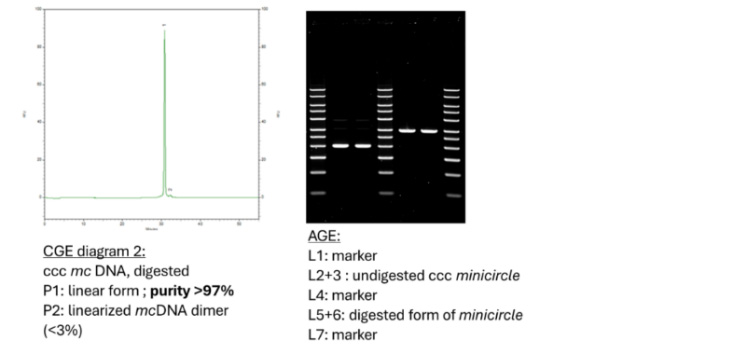
AGE and CGE analysis confirm highly pure plasmid and Minicircle DNA with >95% supercoiled content and clean linearization upon request. RNase-free, pre-configured templates are available up to 10 g to support efficient, accurate, and scalable mRNA production.
Preserving Long poly(A) Stretches with POLYARESCUE®

POLYARESCUE® preserves long poly(A) stretches (>120A) in plasmid DNA using proprietary NGS-supported technology and optimized fermentation. This enables homogeneous, high-quality DNA templates for efficient and reliable mRNA production.
Linearization optimizes mRNA production*
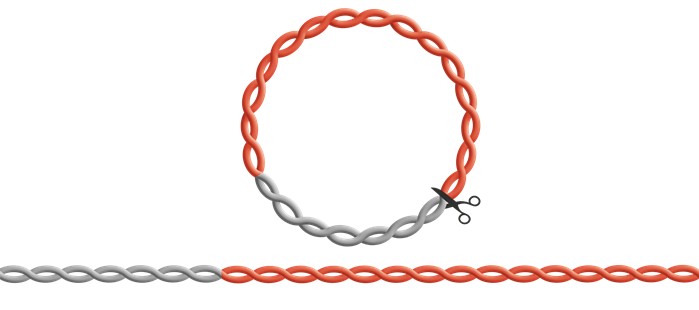
Linearized plasmid and Minicircle templates improve transcription efficiency and accuracy for mRNA production, while Minicircles provide cleaner IVT templates with fewer unwanted sequences and POLYARESCUE® compatibility (*H. Henschel).
References
- Shankar, R., Schmeer, M. & Schleef, M. (2024). Producing Plasmid DNA Template for Clinical Grade RNA Vaccine Manufacture. Methods in Molecular Biology.
- Shankar, R. et al. (2024). Template plasmids for mRNA production – focus on poly(A) elements. 31st ESGCT Annual Congress / Human Gene Therapy abstract.
- PlasmidFactory GmbH (2021). Production of plasmid DNA as starting material for mRNA vaccines. News & Stories.
- Henschel, H. (2012). Linearization optimizes mRNA production. Bachelor thesis, HAW Hamburg.