
Next-Generation Virus-Free Gene Modification for Advanced Cell Therapy
Introduction
Engineering primary human cells for advanced therapies demands DNA that enables high modification efficiency, stable therapeutic expression, preserved cell viability, and seamless clinical scale-up. This must be achieved while reducing the cost, complexity, biosafety burden, and manufacturing limitations often associated with viral vector workflows such as lentivirus.
To optimize the efficacy of cellular therapies, developers are increasingly moving beyond classical viral engineering strategies. Virus-free gene modification programs are expanding rapidly, driven by faster development cycles, simplified handling, lower QC complexity, broader cargo flexibility, and a more scalable path toward clinical manufacturing.
This shift reflects a growing preference for flexible, non-viral engineering strategies that preserve cell phenotype, viability, and long-term therapeutic function. Applications include CAR-T, CAR-NK, TCR-T, hematopoietic stem cell engineering, CRISPR-based knock-ins, transposon systems such as Sleeping Beauty, and emerging in vivo delivery concepts using lipid or polymer nanoparticles.

The challenge

Developers pursuing virus-free gene modification often encounter bottlenecks that limit efficiency, scalability, safety-related performance, and clinical translation:
- Cell stress and viability loss: Electroporation, nucleofection, or nanoparticle-based delivery can be limited by high DNA input, bacterial backbone load, and DNA-induced toxicity.
- Unstable expression: Long-term therapeutic expression may vary due to cassette silencing or immune activation triggered by bacterial backbone sequences.
- Safety and integration concerns: Backbone-heavy donor DNA or viral systems can increase concerns around disruptive genomic insertion patterns and unwanted sequence carry-over.
- Antibiotic marker concerns: Standard plasmids and mini-plasmid formats may still contain antibiotic resistance genes, creating regulatory concerns for ATMP development.
- Payload and workflow limitations: Viral systems can be limited by cargo size, complex manufacturing, biosafety requirements, and longer development timelines.
- Manufacturing bottlenecks: Translation into late-stage and GMP workflows requires reliable scale-up, consistent DNA quality, and documentation aligned with clinical expectations.
For many advanced cell therapy programs, the key challenge is therefore clear: achieving efficient, affordable, stable, and clinically scalable gene modification without relying on complex viral vector manufacturing (Díez et al., Monjezi et al.).
The solution
Minicircle DNA as an Ideal Vector for Virus-Free Gene Delivery
PlasmidFactory enables scalable virus-free cell engineering by providing high-quality Minicircle DNA as upstream DNA for advanced therapeutic workflows. Our proprietary Minicircle technology generates small, supercoiled, bacterial backbone-free DNA vectors focused on the gene of interest — without antibiotic resistance genes or other bacterial backbone elements in the final Minicircle product.
This makes Minicircle DNA particularly well suited for non-viral delivery platforms where DNA quality, size, topology, and purity directly influence transfection efficiency, cell viability, expression stability, and downstream regulatory confidence.
Backbone-Free DNA for Reduced Toxicity and Cleaner Engineering
Minicircle DNA removes bacterial elements such as origins of replication and antibiotic resistance genes from the final vector. This reduces non-essential DNA load, minimizes immune-activating carry-over, and lowers DNA-associated toxicity during demanding delivery procedures such as electroporation or nucleofection.
The result is a compact, supercoiled DNA molecule that focuses cellular resources on the therapeutic cassette rather than bacterial backbone sequences. This can support improved transfection performance, stronger expression, reduced silencing, and more robust cell engineering outcomes.
Efficient Non-Viral Engineering Across Platforms
Minicircle DNA is compatible with a broad range of virus-free gene modification strategies, including:
- Sleeping Beauty transposon systems for stable CAR, TCR, or transgene integration
- CRISPR-mediated knock-ins using Minicircle donor DNA templates
- Electroporation and nucleofection of primary T cells, NK cells, and HSCs
- LNP/PNP-based delivery for emerging ex vivo and in vivo approaches
- Non-integrating episomal concepts, including S/MAR-based applications where appropriate
This flexibility allows developers to design workflows for stable integration, targeted knock-in, transient expression, or episomal maintenance depending on the intended therapeutic strategy.
Proven Use in Advanced Cell Therapy Programs
Minicircle DNA has already been used in several clinical and translational cell therapy programs, including virus-free Sleeping Beauty-based CAR-T approaches. Examples include CARAMBA-1, TranspoCART19, and LION-1, as well as additional oncology, autoimmune, and gene therapy programs in preparation.
Published and publicly presented data show that Minicircle-based workflows can support functional CAR-T, CAR-NK, TCR-T, HSC, and CRISPR editing applications. In CAR-T manufacturing, Minicircle-based Sleeping Beauty systems have demonstrated tumor eradication comparable to lentiviral approaches, improved genomic safety profiles, prolonged survival in preclinical models, and undetectable residual Minicircle DNA in the final CAR-T product.
In primary human T cells, collaborators reported gene transfer rates consistently above 50–60%, described as 5- to 6-fold higher than with conventional plasmid DNA. In hematopoietic stem cells, Minicircle-based Sleeping Beauty delivery showed reduced cytotoxicity, improved long-term expression, and favorable integration patterns compared with viral vectors.
Clinical Scalability from Research to GMP
PlasmidFactory supports virus-free gene modification programs from early research to clinical manufacturing. Minicircle DNA is available in defined quality grades, including Scientific Quality Grade / CCC Grade, High Quality (HQ) Grade, and GMP Grade, enabling a clear development path from feasibility studies to clinical and commercial applications.
For preclinical and early clinical programs, High Quality (HQ) Grade provides EMA-guideline-aligned material with strong traceability, extended QC, and thorough QA oversight. For later-stage clinical and commercial applications, GMP Grade is manufactured in a dedicated GMP facility using end-to-end single-use upstream and downstream processes, supporting high safety standards, process consistency, and regulatory readiness.
With more than 25 years of DNA manufacturing expertise, 3,500+ plasmid and Minicircle projects delivered, and a 99.9% success rate, PlasmidFactory provides a reliable foundation for virus-free cell therapy development.

Results: Efficient, Scalable, Virus-Free Cell Engineering
Publicly available and collaborator-generated data highlight the value of high-integrity, backbone-free Minicircle DNA for advanced cell therapy workflows:
- Efficient CAR-T manufacturing: Minicircle + Sleeping Beauty systems enabled clinical-scale generation of functional CAR-T cells with tumor eradication comparable to lentiviral CAR-T approaches (Díez et al., Monjezi et al.).
- Improved genomic safety: Minicircle-based CAR-T workflows showed favorable integration profiles, low vector copy numbers, and absence of non-integrated Minicircle DNA in the final CAR-T product (Díez et al., Monjezi et al.).
- High gene transfer rates: Primary human T-cell engineering with Minicircle DNA achieved gene transfer rates above 50–60%, reported as 5- to 6-fold higher than conventional plasmid DNA (Monjezi et al.).
- Reduced cytotoxicity in HSCs: Minicircle-based Sleeping Beauty delivery was approximately 20-fold more efficient than plasmid DNA and associated with up to 50% reduced cellular toxicity in human CD34+ cells (Holstein et al.).
- Efficient CAR-NK generation: Minicircle-enabled Sleeping Beauty engineering supported stable CAR expression in primary NK cells, improved genomic safety, and strong anti-leukemic activity in vitro and in vivo (Bexte et al.).
- CRISPR donor compatibility: Minicircle DNA can serve as a backbone-free donor template for HDR- and HITI-based cassette knock-in workflows (Tennant et al.).
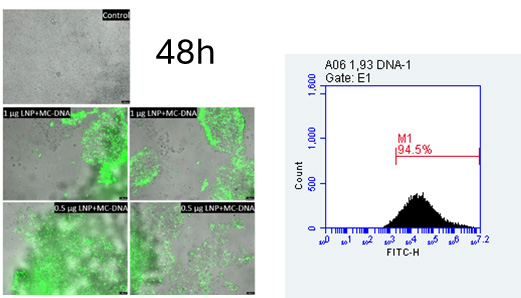
- LNP compatibility: Proof-of-principle data show successful Minicircle DNA delivery using lipid nanoparticles, with persistent GFP expression from 24 h to 144 h in HEK293 cells (Czapla et al.).
- Efficient TCR-T manufacturing: Minicircle donors achieved the highest TCR knock-in and TCR replacement efficiency in a combined Sleeping Beauty / CRISPR workflow, outperforming standard plasmid, mini-plasmid, and synthetic DNA formats (Lennerz et al.).
Data highlights:
Generation of functional CAR-T Cells using a Minicircle-based Sleeping Beauty Transposon System
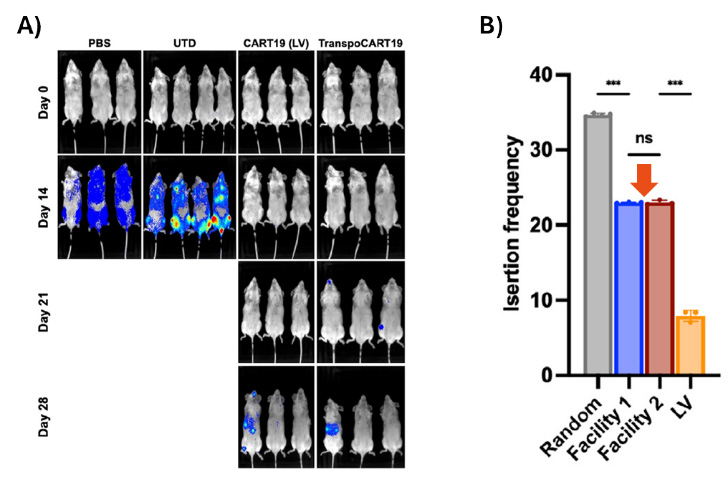
(A) Bioluminescence imaging of NALM6 leukemia in NSG mice shows TranspoCART19 cells generated with SB100X mRNA and Minicircle DNA rapidly cleared tumors comparable to lentiviral CAR T cells, whereas controls showed progressive disease. (B) Insertion-site analysis shows SB-transposon CAR T cells display a near-random integration profile with increase insertions in genomic safe harbors compared to lentiviral vectors, indicating reduced genotoxicity risk (Diez et al.).
Minicircle enables efficient virus-free generation of CAR-NK cells

Schematic of Sleeping Beauty–mediated CAR integration in NK cells using Minicircle DNA (Bexte et al.)
CRISPR Editing using a Minicircle Donor DNA Template Carrying a Fluorescent Insertion Cassette

Successful in vivo knock-in (mouse embryonic fibroblasts) of fluorescence transgene cassettes (EGFP; yellow) using a MC as HDR- and HITI donor (only HDR shown). NHEJ: Non-Homologous End Joining. HDR: Homology-Directed Repair. HITI: Homology-Independent Targeted Integration. (Tennant et al.)
Proof of principle: LNP-Transfection with Minicircle DNA
Successful in vivo knock-in (mouse embryonic fibroblasts) of fluorescence transgene cassettes (EGFP; yellow) using a MC as HDR- and HITI donor (only HDR shown). NHEJ: Non-Homologous End Joining. HDR: Homology-Directed Repair. HITI: Homology-Independent Targeted Integration. (Tennant et al.)
Efficient Non-Viral Gene Delivery into HSC using a Minicircle-based Sleeping Beauty Transposon System
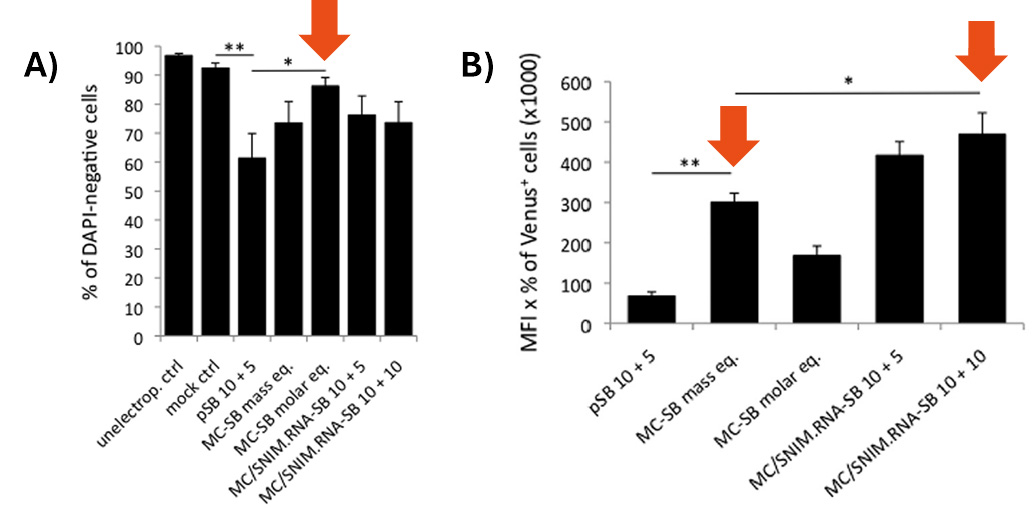
Two days post-nucleofection in CD34+ cells, Minicircle-based Sleeping Beauty transposon delivery resulted in lower cytotoxicity, reflected by a higher percentage of DAPI-negative viable cells, than the fully plasmid-based approach. (B) It also produced the highest overall transient gene expression (Venus+ cell frequency × MFI), with the best performance observed when the transposon was delivered on a Minicircle, while SB transposase delivery on plasmid or RNA showed similar results.
Non-Viral Manufacturing of Tumor-Specific TCR-T Cells for Immunotherapy of Solid Cancers using Minicircle

Minicircle-based non-viral engineering of tumor-specific TCR-T cells achieved the highest transgenic TCR knock-in while maintaining efficient knockout of the endogenous TCR. Compared with Competitor 1 and Competitor 2 (Comp 1 & 2), the Minicircle approach (pMC) showed the most favorable overall editing outcome, with black bars indicating endogenous TCR and colored bars indicating TCR knock-in.

References
- Díez, B. et al. (2025). Generation and GMP scale-up of human CAR-T cells using non-viral Sleeping Beauty transposons for B cell malignancies. Molecular Therapy: Methods & Clinical Development.
- Monjezi, R. et al. (2017). Enhanced CAR T-cell engineering using non-viral Sleeping Beauty transposition from minicircle vectors. Leukemia.
- Holstein, M. et al. (2018). Efficient Non-viral Gene Delivery into Human Hematopoietic Stem Cells by Minicircle Sleeping Beauty Transposon Vectors. Molecular Therapy.
- Bexte, T. et al. (2024). Engineering of potent CAR NK cells using non-viral Sleeping Beauty transposition from minimalistic DNA vectors. Molecular Therapy.
- Tennant, P. A. et al. (2020). Fluorescent in vivo editing reporter (FIVER): A novel multispectral reporter of in vivo genome editing. bioRxiv.
- Lennerz, V. et al. (2025). Non-viral manufacturing of tumor-specific TCR-T cells for immunotherapy of multiple advanced solid cancers. 32nd ESGCT Annual Meeting.