
Advancing AAV Vector Production with High-Integrity DNA Constructs
Introduction
Adeno-associated virus (AAV) vectors are foundational to modern human gene therapy and in vivo gene delivery. Recombinant AAV vectors lack viral coding sequences, making them a leading platform for targeted gene transfer in applications such as monogenic diseases, neuromuscular disorders, ocular diseases, and liver-directed therapies.
However, achieving high titers, reproducible processes, and clinical-grade vector quality remains challenging. AAV manufacturing must balance productivity, genome packaging efficiency, vector purity, safety-related quality attributes, and cost of goods – while minimizing contaminants, empty or partial capsids, unwanted DNA carry-over, and process variability.
Upstream DNA construct quality is decisive. Whether developing single-stranded or self-complementary AAV vectors, the integrity of the AAV genome template – including backbone design as well as full-length, functional ITRs – directly impacts packaging efficiency, vector performance, and batch consistency.
As a technology-agnostic upstream DNA provider, PlasmidFactory addresses these challenges with high-purity plasmid DNA, backbone-free Minicircle DNA, and proprietary technologies such as ITRPROTECT® / ITRRESCUE®. Our solutions are designed to improve titer, purity, ITR integrity, process robustness, and scalability from early research to GMP manufacturing.
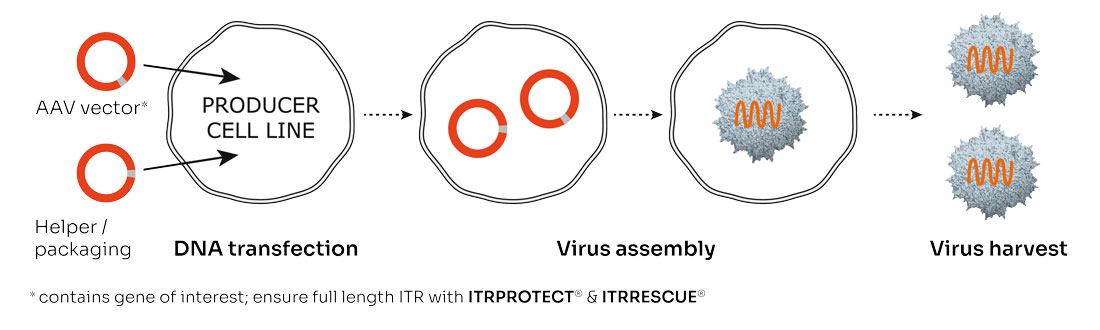
The challenge
AAV producers often face recurring bottlenecks that limit efficiency, scalability, product quality, and safety-related performance. Low or variable yields, impurities, unstable DNA elements, and complex production workflows can increase development timelines, regulatory burden, and cost of goods.
- Limited or inconsistent vector genome titers, leading to repeated optimization cycles and increased development costs
- Impurity carry-over from plasmid backbones, including bacterial sequences and antibiotic resistance genes
- Unintended DNA packaging (“back-packaging”) into AAV particles, potentially affecting vector purity, safety, and batch consistency
- Instability or truncation of inverted terminal repeats (ITRs) during plasmid amplification, reducing packaging efficiency and functional vector yield
- Complex multi-plasmid workflows, such as standard triple transfection systems, increasing QC burden and slowing manufacturing scale-up
Recent studies highlight that both upstream DNA integrity and plasmid backbone composition can directly affect AAV quality and performance. ITR instability can compromise genome packaging, while plasmid backbone-derived sequences may be detected as unwanted DNA carry-over in AAV-related contexts (Schnödt et al., Radukic et al.; Buddle et al.).
The solution
A guide to AAV production excellence
Successful AAV vector production requires optimization of the full upstream DNA system — from plasmid design and topology to ITR integrity, backbone composition, and manufacturing grade. PlasmidFactory provides scalable DNA solutions designed to improve AAV productivity, purity, and reliability across serotypes and production platforms.
Optimized 2-plasmid system
Via our exclusive DKFZ-licensed 2-plasmid system we simplify the production workflow by combining helper and packaging functions on a single element. This approach significantly reduces the complexity and eliminates the need for a live helper virus. The resulting system is efficient, lean and compatible with a wide range of recombinant AAV production protocols.
ITRPROTECT® / ITRRESCUE® for full-length, functional ITRs
Intact ITRs are essential for AAV replication, genome rescue, and efficient packaging. However, ITRs are prone to truncation during plasmid propagation in E. coli, which can compromise AAV yield and purity. Radukic et al. showed that stable maintenance of full-length ITRs improved rAAV yield and genetic purity in HEK293 production systems.
PlasmidFactory addresses this challenge with proprietary ITRPROTECT® / ITRRESCUE® technologies. ITRPROTECT® preserves ITR sequences during amplification exactly as provided by the customer, while ITRRESCUE® enables ITR integrity analysis and, if needed, replacement of truncated or rearranged ITRs with full-length wild-type sequences.
This helps reduce variability and supports predictable AAV packaging performance.

Minicircle technology for cleaner, higher-performing and safer AAV production
PlasmidFactory’s backbone-free Minicircle DNA removes bacterial backbone sequences from the AAV transfer construct, resulting in a small, supercoiled DNA molecule focused on the expression cassette. This improves the functional DNA-to-backbone ratio and can enhance transfection performance in producer cells such as HEK293(T).
For AAV production, Minicircle DNA directly addresses key bottlenecks in vector quality and performance. Schnödt et al. showed that replacing standard plasmids with Minicircle constructs strongly reduces encapsidation of prokaryotic backbone sequences – by more than two orders of magnitude – and can improve transduction efficiency of scAAV preparations by up to 30-fold. The authors concluded that Minicircle technology significantly improves the quality of AAV vector preparations.
By reducing backbone-derived impurities at the source, Minicircle DNA can lower downstream purification burden, improve batch quality, and support a cleaner safety profile. This is increasingly relevant because Buddle et al. identified manufacturing plasmid sequences with complex structures and recombination in liver tissue after AAV gene therapy, highlighting why minimizing plasmid-derived DNA carry-over is an important upstream quality objective.
Clinical scalability for custom AAV programs
PlasmidFactory enables a seamless transition from early research to GMP manufacturing. Our plasmid and Minicircle DNA solutions are available in defined quality grades, including Scientific Quality, High Quality, and GMP Grade, supporting different development stages from discovery to clinical and commercial supply.
For preclinical and early clinical programs, our High Quality (HQ) Grade provides EMA-guideline-aligned material with strong traceability, extended QC, and thorough QA oversight. For later-stage clinical and commercial applications, our GMP Grade is manufactured in a dedicated GMP facility using end-to-end single-use upstream and downstream processes, supporting high safety standards, process consistency, and regulatory readiness.
Whether you are developing an in-house AAV production platform or working within a CDMO manufacturing workflow, our scalable upstream DNA solutions provide a reliable foundation for consistent AAV vector production — from early construct evaluation to GMP-ready manufacturing, with Minicircle DNA already used in several clinical programs beyond AAV applications.
Results: maximized yields in AAV manufacturing
Publicly available data highlight how high-integrity, backbone-free upstream DNA can improve recombinant AAV production:
- Higher titer and purity: Stable maintenance of full-length ITRs improved rAAV yield and genetic purity in HEK293 production systems (Radukic et al., 2025).
- Reduced backbone packaging: Replacing the vector plasmid with a Minicircle reduced backbone-containing particles by more than two orders of magnitude (Schnödt et al.).
- Cleaner dual-Minicircle approach: Replacing both vector and helper plasmids reduced ampR-containing particles to ≤0.004% relative to the intended transgene cassette (Schnödt et al.).
- scAAV purity challenge addressed: Standard scAAV preparations contained up to 26.1% plasmid backbone sequences, compared with up to 2.9% in ssAAV, highlighting the importance of backbone-free templates (Schnödt et al.).
- Improved transduction performance: Minicircle-based scAAV preparations achieved up to 30-fold higher transduction efficiency compared with standard plasmid-based production (Schnödt et al.).
- Safety-relevant purity: Buddle et al. detected manufacturing plasmid sequences, complex structures, and recombination in liver tissue after AAV gene therapy, supporting the need to minimize plasmid-derived DNA carry-over (Buddle et al.).
Data highlights: enhancing AAV vector production
Intact ITRs for more efficient AAV production

rAAV production from different ITR variants. ( A ) Viral genomes (vg) per cell. ( B ) Mispackaged DNA as fraction backbone to vg. ( C ) Fraction ‘full’ capsids. n.s.: not significant. * P < 0.05 (Radukic et al.).
Improved vector purity
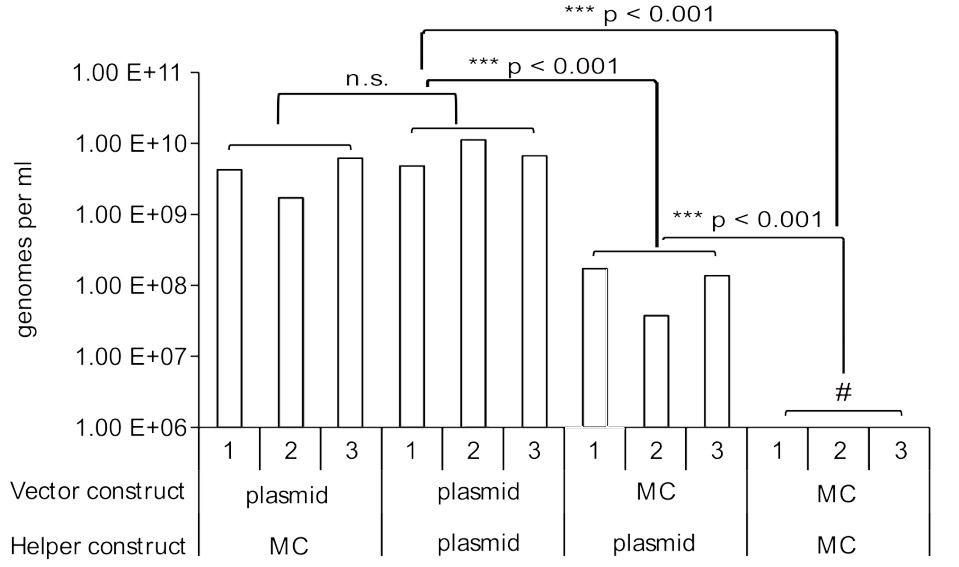
Replacing the vector plasmid by MC significantly decreases the amount of encapsidated backbone DNA particles (Schnödt et al.)
Higher AAV Titers

AAV titers measured 72 h post-transfection were 3–4× higher with Minicircle DNA (MC.AAV-ssGFP + pDG, both PlasmidFactory) vs. plasmid DNA (pAAV-ssGFP + pDG, both PlasmidFactory) (Kraemer et al.)

References
- Schnödt, M. et al. (2016). DNA Minicircle Technology Improves Purity of Adeno-associated Viral Vector Preparations. Molecular Therapy—Nucleic Acids.
- Radukic, M. T. et al. (2025). Degradation and stable maintenance of adeno-associated virus inverted terminal repeats in E. coli. Nucleic Acids Research.
- Buddle, S. et al. (2025). Contaminating plasmid sequences and disrupted vector genomes in the liver following adeno-associated virus gene therapy. Nature Medicine.
- Kraemer et al., 31st ESGCT Annual Congress 2021